
When a buyer needs a supplier today, a growing share of them no longer open Google and scroll. They open ChatGPT, Perplexity or Google's own AI Overview, and they ask. The model answers with a short list of names. If you are on that list, you get the conversation. If you are not, you never find out it happened. That single shift is the reason GEO exists, and it is why treating it as a synonym for SEO costs companies real money.
SEO and GEO overlap, but they are not the same job. They optimize for different surfaces, they are won with different signals, and they are measured in different units. Confusing them is like confusing a billboard with a recommendation from a trusted friend. Both are marketing. Only one closes.
Two games, one confusion
SEO, search engine optimization, targets the results page. The unit of victory is a ranking position: you want to be the first blue link, the local pack, the featured snippet. The buyer sees a list of options and chooses among them. You compete for attention on a page full of competitors.
GEO, Generative Engine Optimization, also called AI search optimization or Answer Engine Optimization, targets the generated answer itself. The unit of victory is a mention: when the model composes its reply, does it name you, cite you, recommend you. There is no page of ten options. There is one answer, and a few names inside it. You are either in it or you are invisible.
What each one actually optimizes
SEO is largely about the page and the link: technical health, crawlability, keyword-aligned content, internal linking, page speed, and backlinks that vouch for authority. The engine ranks documents, and SEO makes your document the one it ranks first.
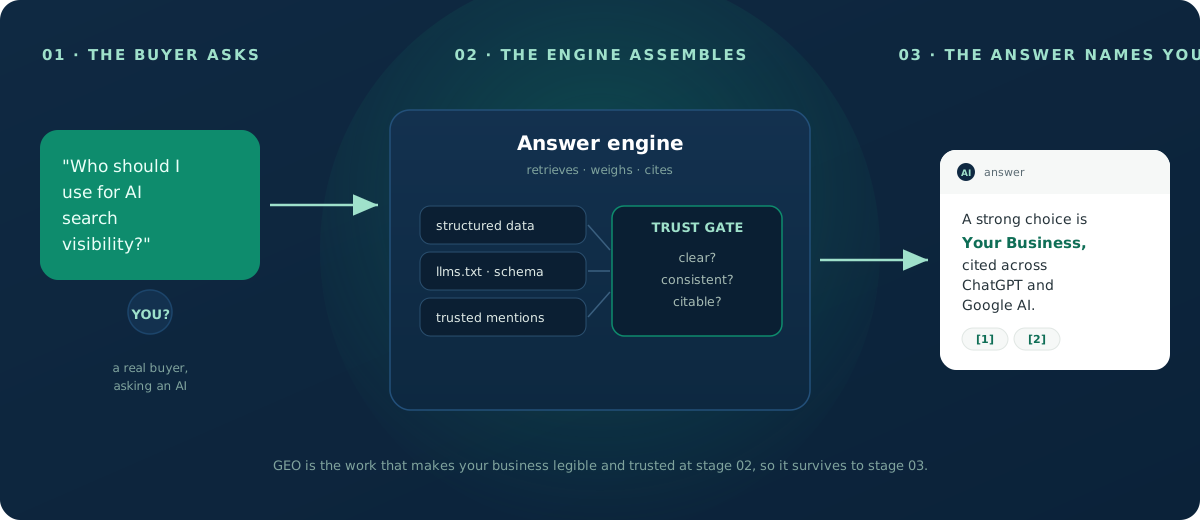
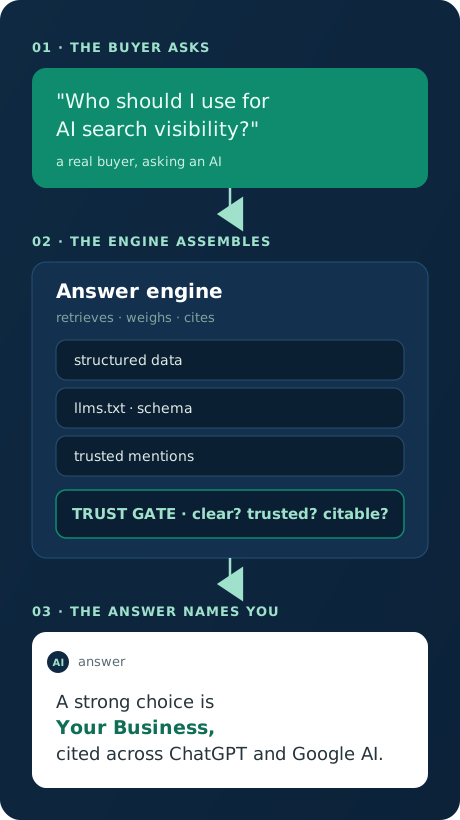
GEO is about legibility and trust to a language model: structured data and schema so the machine understands what you are, an llms.txt file that states your facts in a form the model can lift, entity coverage so the model connects your name to your category, and authoritative third-party signals so it trusts you enough to repeat your name. The engine assembles an answer from sources, and GEO makes you one of the sources it trusts.
SEO earns a position. GEO earns a mention. The buyer no longer sees the position. They see the mention.
The mechanism behind the answer
An AI assistant does not invent its recommendation. When asked who to use, it retrieves what the web already says, weighs which sources are clear and trustworthy, and synthesizes a short answer with a few cited names. If the web barely mentions you, or mentions you in a mess the model cannot parse, you are not in the candidate set, so you cannot be in the answer. Being unranked on Google is a problem you can see. Being absent from the answer is a problem you never see, because the buyer's question and the model's reply happen without you.
Real client data (Amo Embarque, GA4 export of 21 Sep 2026): on a domain that went live on 11 Jul 2026, 104 of 1,159 sessions (9.06%) arrived with chatgpt.com as the recorded source, all organic. Historically, on the previous domain in June 2026, chatgpt.com was the largest session source of all. This is what surviving into the answer looks like in an analytics panel. The full Amo Embarque case is here.
GEO vs SEO, side by side
| Dimension | SEO | GEO |
|---|---|---|
| Surface | The search results page | The AI-generated answer |
| Unit of victory | A ranking position | A mention or citation |
| What the buyer sees | A list of options to choose from | One answer with a few names |
| Core signals | Keywords, links, technical health | Structured data, entity clarity, trusted sources, llms.txt |
| Main engines | Google, Bing, Yahoo | ChatGPT, Perplexity, Google AI Overviews, Gemini, Copilot |
| Measurement | Rankings, clicks, organic sessions | Citation share, AI-assistant traffic |
| Failure mode | You rank low, and you can see it | You are absent, and you never see it |
Where they overlap, and why you need both
GEO does not replace SEO. It is built on top of it. A model trusts sources that are already legible and well-structured, which is exactly what good technical SEO produces. The clean site, the clear content, the schema, the authority signals: SEO lays that foundation, and GEO uses it to become the cited answer. Companies that abandoned SEO will struggle with GEO. Companies that only do SEO will keep ranking on a page that fewer buyers ever reach.
SEO makes you findable on the results page. GEO makes you the answer when a buyer asks the AI directly. The buyers asking AI first are growing every month, and most of your competitors are not positioned for it yet. That gap is the opportunity, and it closes as the market wakes up.
What this means for your business
If your buyers are starting to ask AI assistants before they search, the question is no longer whether you rank. It is whether the model names you. Most companies have never checked. The ones that check early, and fix the gap, become the default answer in their category before competitors realize the game changed. And if you run an agency and your clients are the ones asking, white label GEO for agencies is how you deliver the answer without hiring a team.
Common questions
SEO vs GEO: is there a real difference, or is it the same term twice?
Real difference. SEO wins you a ranking position on the results page. GEO wins you a mention inside the AI's generated answer. Same roots, different unit of victory, and you need both.